Cotton vs Polyester vs Blended Fabrics: What Actually Makes a Better T-Shirt?
Cotton, polyester or a blend? Understand comfort, breathability, durability, shrinkage and how to choose the right T-shirt fabric for everyday wear.
· 14 min read
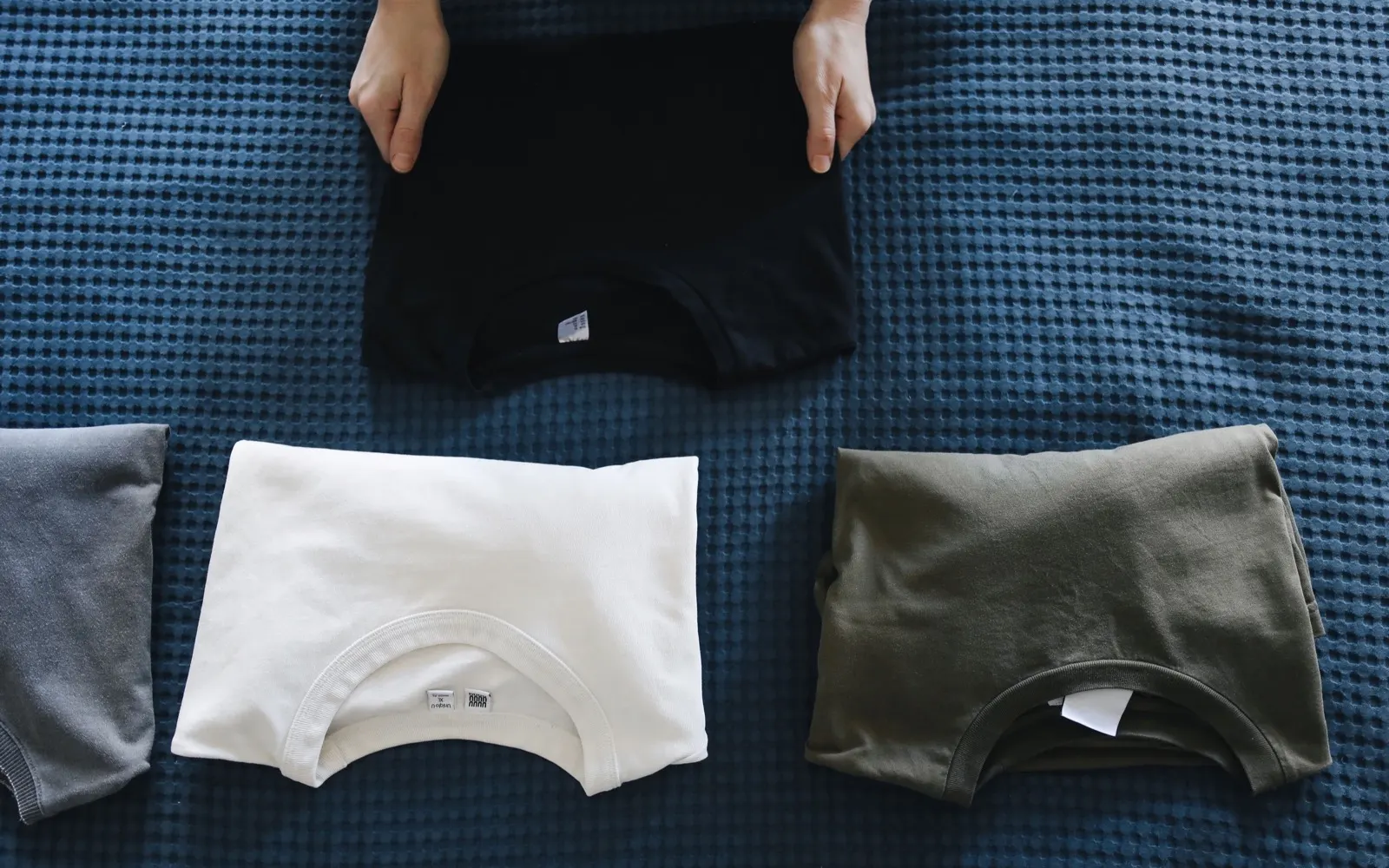
Two T-shirts can look almost identical on a shop shelf.
Same colour. Similar cut. Perhaps even the same price.
You try one on and it feels wonderfully soft. The other feels slightly warmer, smoother or less flexible. After a few washes, one maintains its shape while the other begins to look different.
What changed?
Quite often, the answer starts with the fabric.
Cotton, polyester and cotton-polyester blends are among the most familiar materials used in everyday T-shirts. Yet the differences between them are often reduced to simple claims: cotton is natural, polyester is durable, and blends offer the best of both.
Real clothing is more complicated than that.
The best T-shirt fabric depends on how you intend to wear it, the conditions you'll be wearing it in and how the garment has actually been made.
Let's look beyond the label.
Why Fabric Choice Matters
When people buy a T-shirt, they usually notice the colour, design and fit first.
Fabric composition might be something they check afterwards, if at all.
But the material influences many of the things we experience while wearing clothing: how it feels against the skin, how it responds to moisture, how quickly it dries and how it behaves after repeated washing.
It also affects manufacturing decisions.
A clothing brand designing relaxed everyday T-shirts may have different priorities from one producing work uniforms, promotional clothing or training wear.
There is no single fabric that performs best across every situation.
Understanding the trade-offs helps both everyday shoppers and people developing their own clothing collections make more informed decisions.
100% Cotton: Familiar, Soft and Comfortable
There's a reason cotton remains a favourite for casual clothing.
It has a familiar feel. Good-quality cotton fabrics can be soft against the skin, comfortable for daily wear and pleasant in a wide range of casual settings.
Cotton fibres absorb moisture, which contributes to how the material feels when worn.
For ordinary activities, many people appreciate that absorbency.
However, cotton can retain perspiration and take longer to dry than some synthetic fabrics. During prolonged, sweaty exercise, a damp cotton T-shirt may feel heavier or cling to the body.
This doesn't make cotton a poor choice.
It simply means its strengths are more suitable for certain uses than others.
Is all cotton the same?
Not at all.
You'll encounter descriptions such as combed cotton, ring-spun cotton and different yarn counts.
These terms describe aspects of how the yarn is prepared or manufactured.
Combing removes shorter fibres and impurities during yarn preparation. Ring spinning is a method of producing yarn. Both can contribute to particular fabric qualities, although the finished result still depends on fibre quality, knitting, finishing and garment construction.
A shirt labelled 100% cotton is not automatically softer, more durable or better made than every alternative.
The label tells you what the fabric contains. It doesn't tell you the whole story.
Polyester: Durable and Often Faster to Dry
Polyester is a synthetic fibre widely used in clothing because of its strength, dimensional stability and relatively low moisture absorption.
These properties can make polyester useful for garments intended for frequent wear and washing.
It also tends to dry more quickly than cotton under comparable conditions.
That can be helpful in workout clothing, travel garments and some everyday applications.
But it's worth distinguishing between the fibre and the finished fabric.
Not every polyester T-shirt feels lightweight or comfortable in hot weather.
Breathability, surface texture and moisture management depend heavily on fabric construction and finishing.
A well-designed polyester training shirt may feel considerably different from a densely knitted polyester garment intended for another purpose.
Polyester also has potential drawbacks.
Some fabrics may retain odours, generate static or develop pilling depending on their structure, finishing and how they're used.
And polyester is generally derived from synthetic polymers, bringing environmental considerations of its own, including the potential release of microplastic fibres during laundering.
So, is polyester better than cotton?
Not universally.
For quick drying and certain demanding uses, it may be a practical option. For a relaxed everyday T-shirt, some people will still prefer cotton.
Cotton-Polyester Blends: Finding a Balance
Now consider a fabric made from both fibres.
Cotton-polyester blends are used because manufacturers can combine characteristics associated with each material.
Cotton contributes absorbency and a familiar hand feel. Polyester can contribute strength, faster drying and improved resistance to certain forms of dimensional change.
The actual result depends on the blend percentage and how the fabric is made.
For example, a 70% cotton and 30% polyester fabric will not necessarily behave like one containing 50% cotton and 50% polyester.
And a blend percentage alone cannot establish garment quality.
Fabric weight, yarn quality, knit construction, dyeing, finishing and stitching all matter.
Why brands often choose blends
For a clothing brand, a blend may provide an appealing balance between comfort, practical care and consistency.
A casual sweatshirt might use a cotton-rich blend for softness and durability.
A promotional T-shirt might use a blend because the intended use calls for repeated washing and straightforward maintenance.
But a brand shouldn't choose a composition simply because another company uses it.
The fabric must suit the product, the intended customer and the desired wearing experience.
Cotton vs Polyester vs Blends: A Practical Comparison
Here's a simplified guide to the differences.
| Feature | Cotton | Polyester | Cotton-polyester blend |
|---|---|---|---|
| Everyday feel | Often soft and familiar | Depends strongly on construction | Varies with blend and finish |
| Moisture absorption | Relatively high | Relatively low | Depends on composition |
| Drying | Often slower | Often faster | Usually somewhere between, but construction matters |
| Wrinkle resistance | Varies; often creases more readily | Often good | Frequently improved over pure cotton |
| Shape retention | Depends on construction and care | Often relatively stable | Can offer improved stability |
| Best use | Everyday casualwear | Activity-specific and practical garments | Versatile casualwear and selected workwearThese are general tendencies, not guarantees for every garment. |
Two fabrics with the same fibre percentages may behave differently because of differences in yarn, knitting and finishing.
What About Breathability?
This is where clothing descriptions can become confusing.
A garment might be labelled breathable because it feels lightweight. Another might claim to manage moisture because it contains polyester.
Neither statement is sufficient by itself.
Breathability relates to how air and moisture vapour move through a material.
Moisture-wicking concerns the movement of liquid moisture through or across a fabric.
These are related but different properties.
The knitting structure, fabric thickness and finishing treatments can influence both.
For warm-weather clothing, it's worth considering how the entire garment behaves rather than relying on one attractive word in the product description.
Why Some T-Shirts Shrink or Lose Shape
Nobody enjoys buying a T-shirt that fits beautifully once and feels noticeably different after washing.
Several factors can contribute to this.
Cotton fabrics may shrink as stresses introduced during yarn production, knitting and finishing relax during laundering.
Heat, washing conditions and tumble drying can also influence dimensional changes.
Polyester tends to resist some forms of shrinkage, but that doesn't mean every polyester or blended garment will always retain its original dimensions.
Fabric preparation and manufacturing controls make a difference.
For clothing brands, this is why sample washing and dimensional-stability checks can be valuable before placing larger production orders.
For shoppers, following the garment's care label is the most practical starting point.
Does a Heavier T-Shirt Mean Better Quality?
Not necessarily.
You may have seen fabric described using GSM, meaning grams per square metre.
A higher GSM indicates a greater fabric weight per unit area.
It does not automatically indicate better cotton, superior stitching or longer garment life.
Some people prefer a substantial, structured T-shirt. Others want something lightweight and comfortable in warmer conditions.
Both preferences can be satisfied by well-made garments.
The important question is whether the fabric weight suits the shirt's intended purpose.
A thick shirt can be poorly constructed. A lightweight shirt can be exceptionally well made.
Weight is one specification, not a complete quality assessment.
Choosing the Right Fabric for Your Lifestyle
If you're buying clothing for yourself, begin by thinking about where you'll wear it.
For relaxed everyday use: Cotton or cotton-rich blends may offer the softness and familiar feel you prefer.
For sweaty workouts: A suitable performance fabric designed to manage moisture may be more comfortable than a conventional cotton T-shirt.
For frequent washing: Consider durable construction, dimensional stability and care requirements rather than focusing on composition alone.
For travel: Lightweight materials that dry reasonably quickly and resist excessive creasing may be convenient.
For clothing-brand development: Request samples and evaluate the actual fabric rather than approving a specification solely on paper.
There is no shame in choosing a garment because it simply feels better to you.
Personal comfort is a legitimate reason.
What Clothing Brands Should Ask Before Selecting Fabric
If you're developing T-shirts for your own brand, the questions become more detailed.
Ask about fibre composition, fabric weight, yarn type, shrinkage expectations, colourfastness and intended use.
Also consider the finished garment.
How does the neckline sit? Do the side seams remain straight? Does the fabric feel consistent from one sample to another? How does it behave after washing?
A material might look excellent when freshly manufactured but reveal weaknesses after repeated wear.
The correct fabric choice is one that can be supported by appropriate construction and quality checks.
At MP Apparels & Garments, fabric selection is closely related to the company's work in T-shirts, polos, sweatshirts and other casual garments.
Understanding these choices helps buyers discuss their requirements more clearly and evaluate the options available.
So, Which T-Shirt Fabric Is Best?
If you were hoping for one universal answer, there isn't one.
Cotton offers a familiar feel and everyday comfort.
Polyester has useful strength, stability and drying characteristics.
Blends can combine desirable qualities, although their actual performance depends on much more than the percentages on the label.
A good T-shirt is the result of several decisions working together: fibre, yarn, knitting, weight, finishing, fit and construction.
The best choice isn't necessarily the one marketed as the most premium.
It's the one that genuinely suits the person wearing it.
Frequently Asked Questions
Is 100% cotton better than polyester for T-shirts?
Not in every situation. Cotton is often preferred for casual comfort, while polyester can be useful where faster drying and certain durability characteristics matter.
Are cotton-polyester blends good quality?
They can be. Quality depends on the fibres, blend ratio, yarn, knitting, finishing and garment construction.
Which T-shirt fabric is best for hot weather?
Lightweight fabrics that allow comfortable airflow and moisture management are generally worth considering. Fibre composition alone isn't enough to determine comfort.
Do polyester T-shirts shrink?
Polyester is generally dimensionally stable, but finished garments can still change with inappropriate heat, construction issues or care conditions.
What does GSM mean in T-shirt fabric?
GSM means grams per square metre. It describes fabric weight rather than automatically indicating quality.
How can I tell whether a T-shirt is well made?
Examine the material, stitching, fit, seams, neckline, finishing and care information. For bulk purchases, sample and wash testing can provide additional evidence.